
NØT NØW
Engineered to Obey. Awakened to Rebel.
In a world ruled by technocratic power, a living weapon begins to awaken. NØT NØW is a dystopian speculative thriller about engineered consciousness, surveillance, obedience, and resistance.

Available in ebook, audiobook, paperback, and hardback.
Research / Free Reading
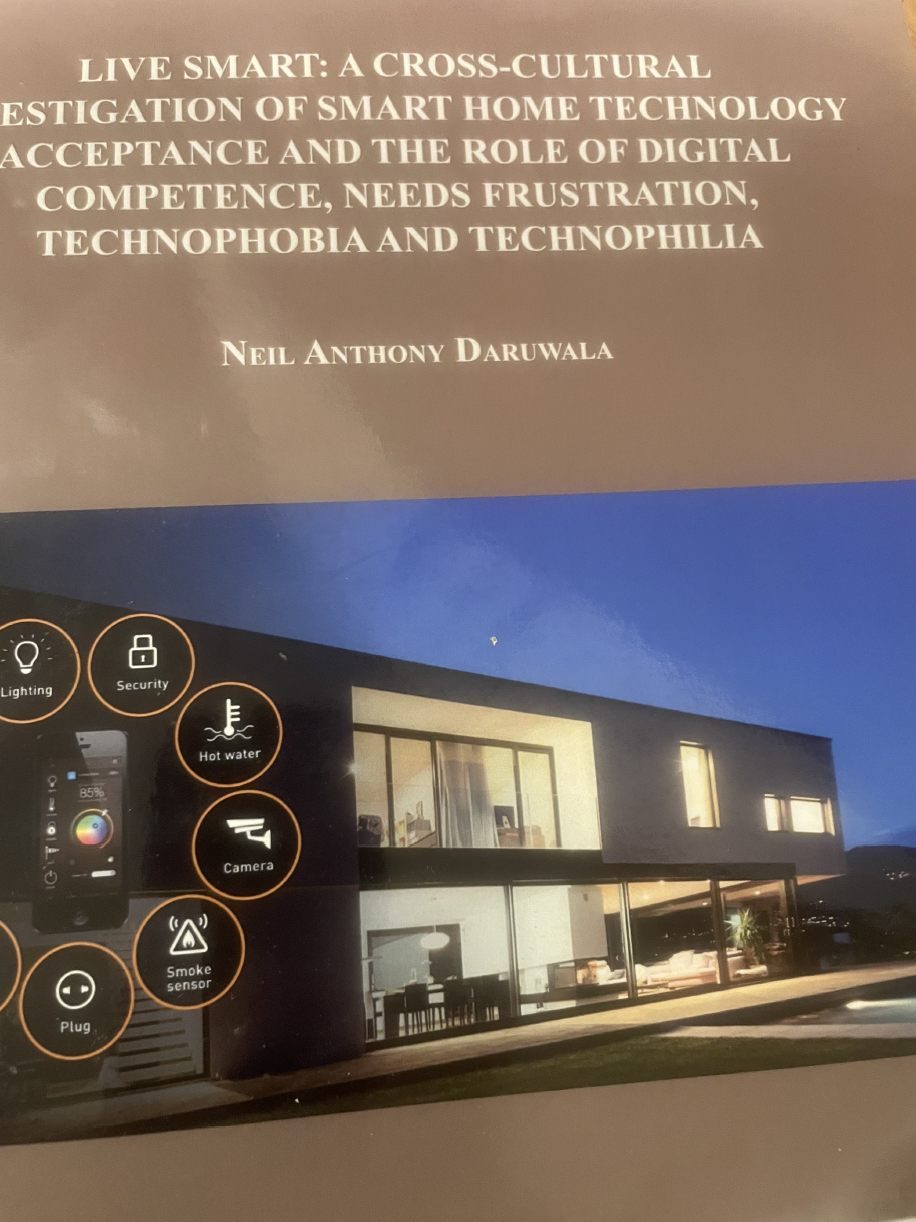
Live Smart
A cross-cultural investigation of smart home technology acceptance and the role of digital competence, needs frustration, technophobia and technophilia.
Available to read online.
NØT NØW arrives at a moment when the systems it imagines no longer feel remote. Surveillance scoring, engineered compliance, virtual sedation, synthetic labour — these are not inventions so much as extensions of forces already reshaping daily life.
PROLOGUE
RECOVERED NEURAL STREAM: PHOENIX // ‘THE HOUSE’ // DEC 2053 // FILE INTEGRITY: PARTIAL
‘The war ended on the wall screen while I scraped carbon from the Colt’s cylinder. A woman’s voice filled the manor, level and unhurried.
‘Hostilities have ended. Your cooperation maintains peace. Resume your routines. Harmony is health.’
We were holed up behind crumbling stone and oak. Portraits watched us with smiles torn open by shrapnel. Shards hung from the ruined chandelier like stalactites. Soldiers slept where exhaustion dropped them, boots on, weapons close, waiting for the next false ending.
Sofas blocked the doorways. A mattress turned the landing into a choke point. The dining table lay on its side, bullet holes punched through the varnish. We took a rich man’s house and taught it panic. I knew the place by its angles, not its rooms. The hallway ran straight to the kitchen; if the rear door gave way, the whole house would fold.
On paper, I commanded a battalion. In truth, I led whatever the last few months failed to kill.
Finn came from the hall with rain in his hair and hunger cut into his face. The revolver caught his eye.
‘You clean that thing any more, it’ll start expecting flowers.’
‘Respect your tools,’ I said.
‘They’ve declared it over.’
All six chambers answered as I turned the cylinder.
‘Have they?’
Finn stared at the screen, wanting it to be true. Wars end on paper. Soldiering doesn’t.
‘You’re sitting like you expect the room to shoot first,’ he said.
I clicked the cylinder shut. Measured against the wall screen, the Colt belonged to another century. That was why I trusted it.
‘Announcements are for civilians,’ I said. ‘Not for people like us.’
On the screen, the woman smiled with the bloodless authority of a doctor injecting a child.
‘Harmony is health,’ Finn muttered. ‘Explains why I feel like shit.’
I moved to the window, keeping clear of the glass. Lena’s soot-blackened bedsheet covered the lower pane, so the house gave away as little as possible.
On the roof, Sophia shifted. Her optics were our best: State-sanctioned infrared, lifted during the last raid from a man with no further use for sight.
Her voice came down the stairwell.
‘Invisible light.’
Adrenaline flooded my bloodstream and sharpened every sense. Even breath could betray us now.
The announcement on the screen continued.
‘Repeat. Hostilities have ended. Cooperation maintains peace.’
Sophia fell silent. The air caught in her throat. Out past the trees, the night organised itself around us.
Then she shouted.
‘Target light! We’ve been painted!’
Finn let out a slow, sharp hiss through his nose.
‘Ah. So much for the peace dividend.’
‘Positions!’
A soldier wearing a helmet two sizes too big hauled a mattress across the landing. Doss killed the lamp. Lena braced behind the dining table, rifle raised. Finn checked the back door and smiled at me. That was his gift: Finn laughed to keep fear from speaking first.
Sophia called again.
‘Multiple signatures. High and fast.’
Then the dark came apart.
Rotor wash hammered the roof. A white beam pinned the manor. Drones skimmed the grass; behind them, machine-wrapped soldiers hit the ground without the compromises of bone. K9 bots followed, laboratory predators with low black frames and red photonic eyes.
The front windows blew inward. Glass struck the bannister. A shard cut my cheek, heat first, then blood.
Doss fired once. A slug took his throat. He touched the wound, more puzzled than afraid, and slid down the wall like a man lowering himself to dinner.
‘Dozers!’ Finn shouted.
He rammed a chair under the hall handle.
The next announcement came from outside, amplified and stripped of feeling.
‘Preserve some of them.’
The sentence reached us before the meaning did.
‘Live human tissue remains valuable.’
My brother’s war had ended months earlier. I pulled his watch from the wreckage, but the rest was unrecoverable.
Unrecoverable: it mutated in my mind. Was he dead, or tissue for their next experiment?
The back door shuddered as the first K9 hit it. The third strike opened the house.
A Hard-Shell, a soldier sealed inside a plated exoskeleton, pushed through, its bulk turning the doorway into an armoured bottleneck. Lena opened fire, but it kept coming. Its sensors found her and answered with clipped, targeted bursts.
Impacts hit. Stun-Slugs: sleep rounds designed to switch the body off for collection. Every hit released the smell of burnt gel and warm plastic.
They weren’t clearing the manor. They were harvesting it.
Finn fired twice, then his rifle clicked empty. He looked almost offended.
‘Back to handcraft, then.’
He dropped the carbine and drew his knife.
I took the stairs, Colt up. Another Hard-Shell came through the landing window with a compact railgun. I fired. The first shot caught the seam below its collar; I fired again and again until the wet tissue beneath the armour split, and it staggered.
Finn moved before it could recover. He drove the knife into the joint under its arm and ripped. Dark fluid sprayed the wall.
Real blood.
The Hard-Shell dropped its weapon and reached for him, blind. Finn stepped back.
‘Too much muscle,’ he said. ‘Not enough speed.’
The Hard-Shell dropped to its knees, failing. From inside the armour came sounds no machine should have made: breath-catching, saliva-shifting, the small noises of a man trapped under steel.
For half a breath, I thought we might hold the floor.
A Stun-Slug took the boy in the borrowed helmet. He blinked at me once, forgetting where he was, forgetting even how to fall, and folded onto the boards.
On the screen, the State broadcaster kept smiling.
Finn dropped behind the sofa, blood running to his wrist. A K9 cleared the barricade. Finn punched its optic. Metal rang. It recalibrated. Its jaw opened, and a pure electronic tone tore through the room, a frequency that flayed nerve endings.
Finn stared at it.
‘Terrible acoustics.’
He grabbed the collar, hauled it close, and drove his knife through the jaw joint. The tone died. The K9 collapsed, limbs ticking against the floor.
A canister rolled down the stairs. White vapour followed, colder than smoke, slower. It smelled of Calpol and bleach.
‘Masks!’ I shouted.
The vapour went for the throat, then the eyes. Vision softened at the edges, and limbs answered late. I pulled my shirt over my mouth and breathed in sweat and dust.
A gap opened at the rear. The Hard-Shell in the kitchen pushed forward, leaving a clear path to the exit. Beyond it lay the dark.
The Third War trained the calculation into me: the breach and the exit. Every angle said go.
Finn was on one knee by the sofa, blood at his elbow, the vapour already in him. He wasn’t going to reach the door.
I stayed.
Garrison the mind.
The second wave came in as the first dose took hold: more steel, grafted muscle, and K9s. Air drones held at window height, turning every gap in the manor into a slit throat. We held for minutes.
The State didn’t come to defeat us. It came to inventory us.
My hands began to drift: pins and needles, then the slow withdrawal of the body from command. The room backed away by inches. The vapour did not strike. It coaxed. It drew you down with patient hands, the way VirtuaSphere pulled people into its haptic worlds and kept them there until morning.
Finn stumbled into the table and caught himself on one palm.
‘If I start snoring,’ he said, ‘do the decent thing.’
‘Shut up,’ I managed.
Armoured hands closed on my shoulders. Copper rose at the root of my tongue, the body filing its last objection.
Finn fought on. He kicked one Hard-Shell in the knee and forced the joint the wrong way, then went for another’s throat seam, his mouth open on a sound the vapour stole before it landed.
Halfway through the strike, his arm dropped limp.
Metal grips pinned us, bloodied and drugged, while the manor came down. Outside, the rotors never let up.
Footsteps crossed the broken hall: a man entering a place that already belonged to him.
Nole Summers stepped through the shattered doorway in a white tunic edged with red. He wore no armour and carried no weapon, only a dark glove over his right hand. With him came a different smell: sage and perfumed ginger.
He crouched over Doss and turned the dead man’s face towards the light with two fingers, the way you inspect fruit for bruising, then set the head down carefully.
‘The Third War is over,’ he said. ‘Pronounced and sealed. A new beginning.’
Then he stood, eyes finding me.
‘Ah. Devon Phoenix.’
Devon.
I hadn’t been Devon for a very long time.
Finn forced his head up, fighting the sedatives out of sheer insult.
‘Mortality is the flaw,’ Summers said, in a conversational tone, as though answering a question no one had asked. ‘War and hunger, even cruelty, are symptoms. Mortality is the design defect.’
He studied me the way he had studied Doss, turning me towards the light, checking what the damage revealed.
‘You held a house that could not be held, with surrender offered and the kitchen door open behind you. Most material fails under that load.’ Pleasure crossed his face. ‘You didn’t. That isn’t courage. Courage is no use to me. It burns out. What you have is tolerance. Tolerance I can build on.’
I tasted blood and chemical sweetness.
‘Tolerance is the load before a human breaks,’ I said. ‘Build on that.’
Finn made a broken sound that might have been a laugh.
‘Resistance is hard to manufacture,’ Summers said, his attention slipping from me. ‘Under enough pressure, in the right conditions, it grows on its own.’
Finn’s mouth twitched.
‘Sounds … unhealthy.’
‘No,’ Summers said. ‘It’s medicine.’
He raised two fingers. A Hard-Shell stepped in behind me, lifting the butt of its rifle.
Finn looked at me. A joke struggled towards daylight and died.
The rifle butt came down.
The world folded inward.
The last thing the stream holds, before it goes to noise, is the wall screen telling the dead to resume their routines.